
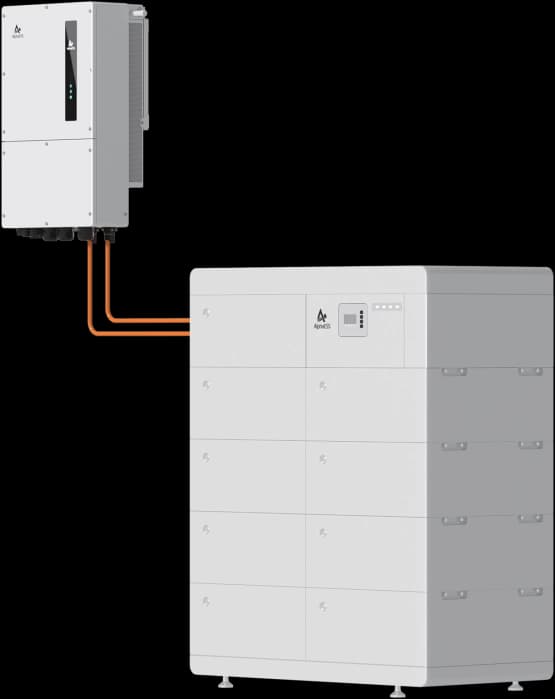
Alpha ESS Stax M30
30 kW, 145 kWh, 150 kW of solar
Grid-tied
Design your solar and storage
Real systems and catalogue prices. The exact fit comes from your half-hourly meter data.
Power
Storage
Alpha ESS Stax M30, 145 kWh, £36,681 for inverter and battery. Slide to add or remove battery modules.
Solar
Roof or ground mount, at £700 per kW installed. Above the inverter's PV limit the array runs on more than one inverter; the design call confirms.
Backup
Your system
30 kW inverter · 145 kWh · 150 kW solar · critical-load backup
from £141,681
Catalogue price for the inverter and battery plus solar at £700 per kW. Cabling, the network connection and any backup switching are quoted on the call. Saving and payback come from your meter data.
Your savings
Your site and your electricity bill, for the system above.
- £–
- Saved a year
- – yrs
- Payback
Pick your site and enter your bill to see the saving.
Included
- Design based on half-hourly energy data
- DNO G99 form application
- Delivery and install
- Tariff and site energy optimisation
- 10-year parts and labour warranty
- Remote monitoring
Worked out from your bill at 30p a kWh, for this system and solar at a typical UK site. The design call sets the real figure from your half-hourly meter data.
Common questions
Straight answers
Will it REALLY save that much?
Yes — and we show you the numbers before anything goes ahead.
Farmers are right to be cautious. A lot of solar salesmen have over-promised in the past.
WattBox is different because:
• We model your real load profile, not generic estimates
• Savings come from tariff differences (cheap → expensive), not optimistic solar assumptions
• Even without new solar, you save simply by charging off-peak and avoiding peak rates
• We don't proceed unless the numbers stack up for your farm
If it won't save you money, we tell you upfront.
Will it handle my peak loads?
Yes — we size the WattBox specifically around your biggest load events (milking, cooling, ventilation, pumps).
We look at:
• Peak kW demand
• Duration of high-load windows
• Motor start currents
• Existing solar/export patterns
WattBox units come in multiple sizes (40–200+ kWh), and we only recommend a system that can comfortably handle your peaks.
If it won't cope, we simply won't sell it to you.
How do I pay for this?
Either up front or via a financing loan, splitting the cost up over 5 years.
This keeps the monthly cost lower than the monthly savings, meaning the system pays for itself from day one.
We can point you towards lenders who understand agricultural energy projects, or you can use your existing bank.
No big upfront hit. Just a steady monthly cost covered by the savings.
What about maintenance? What if it breaks during milking?
WattBox uses industrial-grade Victron hardware, built for continuous operation in tough environments.
• No moving parts
• Remote monitoring 24/7
• Alarms and early-warning notifications
• Most issues can be diagnosed remotely
• On-farm components are modular and easy to service
If something ever did fail, your farm wouldn't go offline — the system automatically falls back to grid power.
In the off chance there is a problem, an engineer will be sent out within 24 hours.
WattBox never interrupts your operations.
Is the DNO going to block it?
Almost always: No.
Battery systems don't increase your maximum demand, so they're normally straightforward for DNOs to approve.
If you already have solar, this is even easier — the paperwork is similar and we handle it for you.
And if export isn't required, it's even simpler.
We take care of the DNO process end-to-end.
Is the install complicated? Will my farm be offline?
Installation is done outside your core operating hours.
Most installs take 1–2 days and require no shutdown of equipment.
• No digging or trenching
• No rewiring of the whole farm
• No disruption to milking or cooling
• System sits outside in its own enclosure
We plan the install around your timetable so nothing stops running.
Can I claim this against the Annual Investment Allowance (AIA)?
Yes — WattBox qualifies for the Annual Investment Allowance (AIA).
That means you can deduct the full cost of your WattBox from your taxable profits in the year you buy it, up to the current AIA limit (£1 million for most businesses).
This can significantly reduce your tax bill and improve the payback even further.
Speak to your accountant to confirm how AIA applies to your specific situation.